
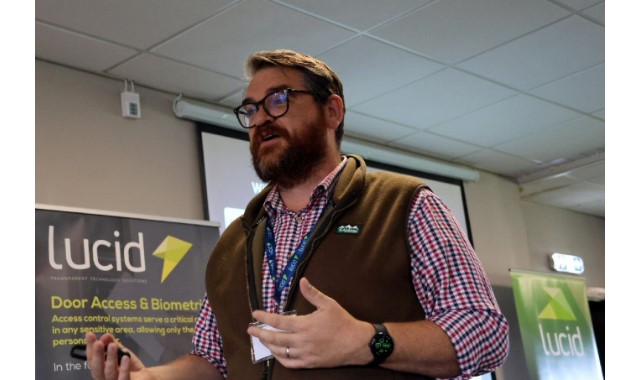
BUSINESSES have been given a powerful insight into AI, from accountancy to Armageddon, at a major conference focussing on the rapidly developing technology.
North East telecoms and connectivity specialists Lucid staged a special symposium for organisations, ranging from law firms to concrete providers and charities, at Darlington Arena, the home of Darlington Mowden Park Rugby Club.
Around 50 delegates expanded their knowledge of AI, which has been grabbing the headlines in recent weeks, thanks to the efforts of leading experts in the field.
Managing director of Stockton-based Lucid, a long-time sponsor of the club, Paul Alsop said: “This is massively topical at every level.
“Jobs are going to change over the next two to five years. It’s about doing more with less effort. But the governance side is important to try and control AI. Many organisations and companies have no idea what is going on.
“AI can do really clever things. At this club it has been fielding calls about the link-up with Newcastle Red Bulls, for instance, without any of the Mowden Park staff having to be involved.
“But a lot of people, from manufacturing to management, lawyers to dentists, are getting things wrong. They are using it like Google when it has to be done right.”
Delegates heard that case law had been written making organisations responsible for their AI and if things went wrong firms could be liable for fines of between £3m and £30m, which could lead to insolvencies and bankruptcies.
In law, if AI was used incorrectly, it could affect client privilege and even lead to contempt of court proceedings.
“But I am incredibly enthusiastic about the technology,” said Paul. “I have worked for 32 years in the industry and the past 10 months have been so exciting.
“But we need to move forward with a degree of caution and must constantly assess the risk. If you let AI loose it can take over the internet which would be no good as humans would no longer be making the key decisions.”
Digital strategist and innovator with Axonyx and Enginuity Matt Atkinson provided delegates with a timeline, which started with wartime code breaker Alan Turing during World War II.
The first reference to AI was at the Dartmouth Workshop in 1956 and it progressed slowly during the 1960 and 70s. In the 1980s computers began to configure computers and the backpropagation algorithm enabled ‘computer learning’ in 1986.
In 1997 IBM’s fast computer Deep Blue beat Russian grandmaster Garry Kasparov at chess and in 2000, during the web boom, AI consumed everything as knowledge was brought together on the internet.
Cloud computing began in 2012 and three years later Open AI was launched. In 2022 ChatGPT went live and by 2024 AI was being used in virtually every system and app.
“By 2025 AI was available in the web browser and without any training or warnings everyone just got stuck in,” said Matt, of Hartlepool.
“Now we have huge business adoption but in terms of control, enforcement and governance we are playing catch-up. We are now worried about it taking over the world and destroying humanity so we need to slow down and take control.
“AI cannot lie but it does hallucinate and invent things. Unless you tell it, it can share company secrets globally for life. With control you can accelerate confidently but you need policies and people in place and then you can look at the business process.”
He said AI was like a drug when people came to appreciate the power of it in transforming processes and productivity. He cited an example of a task that took eight people 22 days to complete; AI did 1,500 similar transactions in just 90 seconds.
He challenged businesses to find out where AI was being used in their operations, what should and should not be allowed, were they able to intervene and were they recording everything for the auditors. “In other words see it, stop it, prove it,” he said.
Delegates also heard from VP of customer experience Stewart Donnor and sales engineer Trevor Creek with European unified communications as a service provider Wildix.
Stewart said: “If you are not using it someone else is which gives them competitive advantage. Once you see what it can do you will want it and it becomes addictive.
“It will be your best employee as it never rings in sick and can work 24/7. But it doesn’t replace staff it augments them and allows them to perform higher tasks. It will do the things the staff don’t like doing like chasing overdue payments. It is multi-lingual and saved one client £12,000 a month in translation fees.”
IT manager with Newcastle law firm Mincoffs Christopher Kewin said: “This has been really interesting in helping us understand AI. It ticks a lot of boxes for us as long as there are safeguards and would be particularly useful out of hours.”
Operations manager for Middlesbrough-based Ready Mix Tees Valley Bex Murphy added: “This would be great for call captures especially as construction tends to work 7am to 4pm.”