
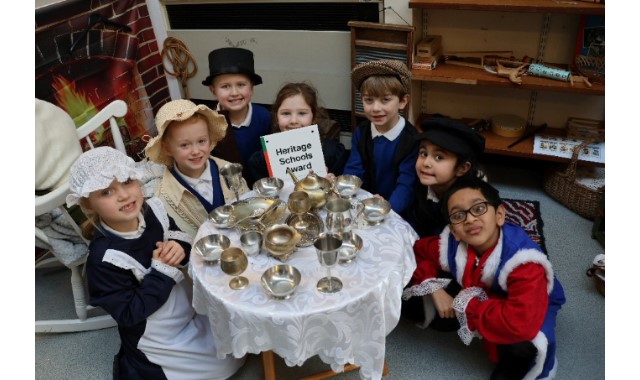
A SCHOOL which has laid a ‘golden thread of history’ through its curriculum has won a national heritage award.
Whinstone Primary School, Ingleby Barwick, has been awarded the Heritage School Award by Historic England in recognition of its dedication to local heritage across the curriculum.
The assessor described as “excellent” the official submission of evidence of the school’s work, which took three months to compile.
“This is no surprise really from an amazing school which is so passionate about local history and heritage,” said Assistant Headteacher Oliver Carlton.
The school ensures that local history and heritage run through the curriculum, with strong examples also seen in art, geography and DT.
Particular praise was given to the units on why locality, the Hartlepool timberyard fire and the way national events, such as the Romans and Vikings, were explored through a local lens.
The assessor also highlighted how local history and heritage had been thoughtfully adapted in the Early Years Foundation Stage. The assessor’s final verdict was, “Just brilliant”.
For the past 18 months the school curriculum has under gone redevelopment. Mr Carlton said: “ I have always believed that local heritage should be a golden thread throughout the whole curriculum and we aim to get it into every topic we do.”
“Our Meanwhile Elsewhere initiative looks at the timeline of history and what was happening in the North East, for example, in the Roman period.”
Whinstone Primary School is part of the Spark Education Trust and Historic England’s project organiser has been out to train its primary school staff and offer advice on resources, including photos, aerial pictures and maps, and how to use directories and census data.
The school also studied employees and production numbers to see the changes caused by the industrial revolution and why the River Tees was so important.
“The maps go back to 1842 and you can see what it was like then and what has changed on the river,” Mr Carlton said. “The children write a letter saying why the River Tees is important to us, what we should be proud of and how we can protect it.
“The award is for how we teach and the curriculum. The whole purpose is to create the bespoke curriculum which matters to our children and it’s great to be recognised and accredited for this work.
“Seeing everything through a local lens helps to put national and global events into context and we are one of the first primaries in the Tees Valley to achieve it.”
Pupils took particular interest in the Stockton Darlington railway which has just celebrated its 200 anniversary.
Year 6 brought in a variety of artefacts including from one pupil who is the eight times removed great grandchild of the founder of the railways George Stephenson.
These included, a bugle horn and a signal changer. During the challenge day, all children at Whinstone Primary School studied their local heritage. EYFS made models outside of the Locomotive and the rest of the school completed activities such as charcoal impressions of the Locomotive and 50s style posters of stops along the line.
“Every generation of her family has had someone working on the railways,” said Mr Carlton, who has a history degree. “Until we started doing this project I had no idea we had one of his descendants in the school and I was thrilled.
“We completed many exciting activities and researched the stops along the line, but it’s important that heritage isn’t just one off events. The Stockton Darlington railway is now permanently on our curriculum for Year 5s, as are bespoke units on preserving our local heritage.”
“When studying Florence Nightingale we also look at local nurses who were involved in the Crimean War. We learn about faraway places but in a way that compares them to the local area. We also have fieldwork opportunities where we go out into the local area – they are the things they remember.”
He had high praise for colleague Suzanna Gibson for developing the history curriculum. “Without that, moving to a heritage approach would not have been possible,” he said. “And this is going to change continually and develop.
“History has always been a passion of mine and we love to give context to how we are influenced by where we live. I love the area and wouldn’t want to live anywhere else. We want people to stay, to work here and make the area even better.”