
THE benefits of reading on babies’ development has been revealed to educationalists by the country’s children’s laureate as new scientific research highlights the power of prose.
Neuro-science has proved that babies’ brains synchronise with their parents when read to and that it brings stability to their otherwise chaotic start to life, delegates at an education conference were told.
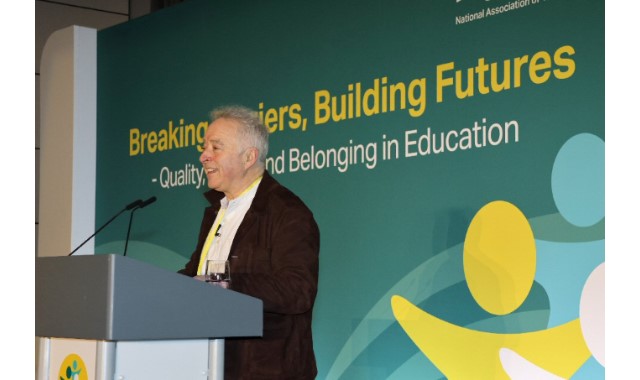
Waterstones Children’s Laureate, author and film-maker Frank Cottrell-Boyce told around 400 delegates attending the 12th annual conference of NAVSH – the National Association of Virtual School Heads – about the power of shared reading.
“There is strong neuro-science behind what happens when you read to children,” said Frank.
“It impacts on their brains. It creates strong rhythms which helps their rhythms become more stable. It helps them to become calm. It helps them understand language. It helps the parent’s and baby’s brain synchronise. It is more than enrichment and bonding, it is something more biological. It is key to becoming a human so we need to defend that space.
“When you are a baby you have begun life as an aquatic creature then you are born and everything is thrown at you. There is so much learning going on. Children want stability, predictability, familiarity and love reading for providing that.”
Reading also helped with kinship relationships – where children are brought up by family members who aren’t their parents.
“John Lennon and Edward Lear were both in kinship care and people who are looked after often become very creative,” he said. “You can use reading as a tool to bring people together. It gives them common purpose and it is incredibly powerful. It is an amazing tool in the development of group relationships.”
Frank said the problem with the digital world was that it was endless with no rhythm. “Watching it for four to six hours a day isn’t entertainment it is sedation,” he said. “Digital metrics are based on someone watching, with the next episode starting in one minute, not falling asleep. That is a huge thing.
“There is something primordial about being read to. It takes us back to moments of connection and your voice is such an important thing. DNA develops the heart first. It’s our clock providing the rhythm that is essential to our lives. We need to tick and tock.”
Virtual head teachers – who are responsible for the education of looked after children and young people with social workers – from all over the country took inspiration from a host of speakers, workshops and panel events at the two-day conference, entitled Breaking Barriers, Building Futures – Quality, Equity and Belonging in Education, staged in Birmingham.
Darlington Virtual School Head Calvin Kipling, who has completed six years on the board of Trustees, said “NAVSH works because it keeps things real, its practitioners and leaders being open about what’s working and what isn’t and what we are going to do about it for our children. It has certainly helped me help the children of Darlington over the past decade.”
Parliamentary undersecretary for the Department for Education and MP for Whitehaven and Workington Josh MacAlister told delegates: “If children don’t have love then it makes their mental health really poor. This has to be about establishing life-long loving relationships.”
He said the previously failing SEND system had increased pressure with families having to battle for help rather than being supported. But the changes proposed for this year would add considerable resources. He said: “We have a plan, we have the money and we are getting on with it. If we can move the dial then we can see them lead successful lives. We need to do more, try harder and go further.”